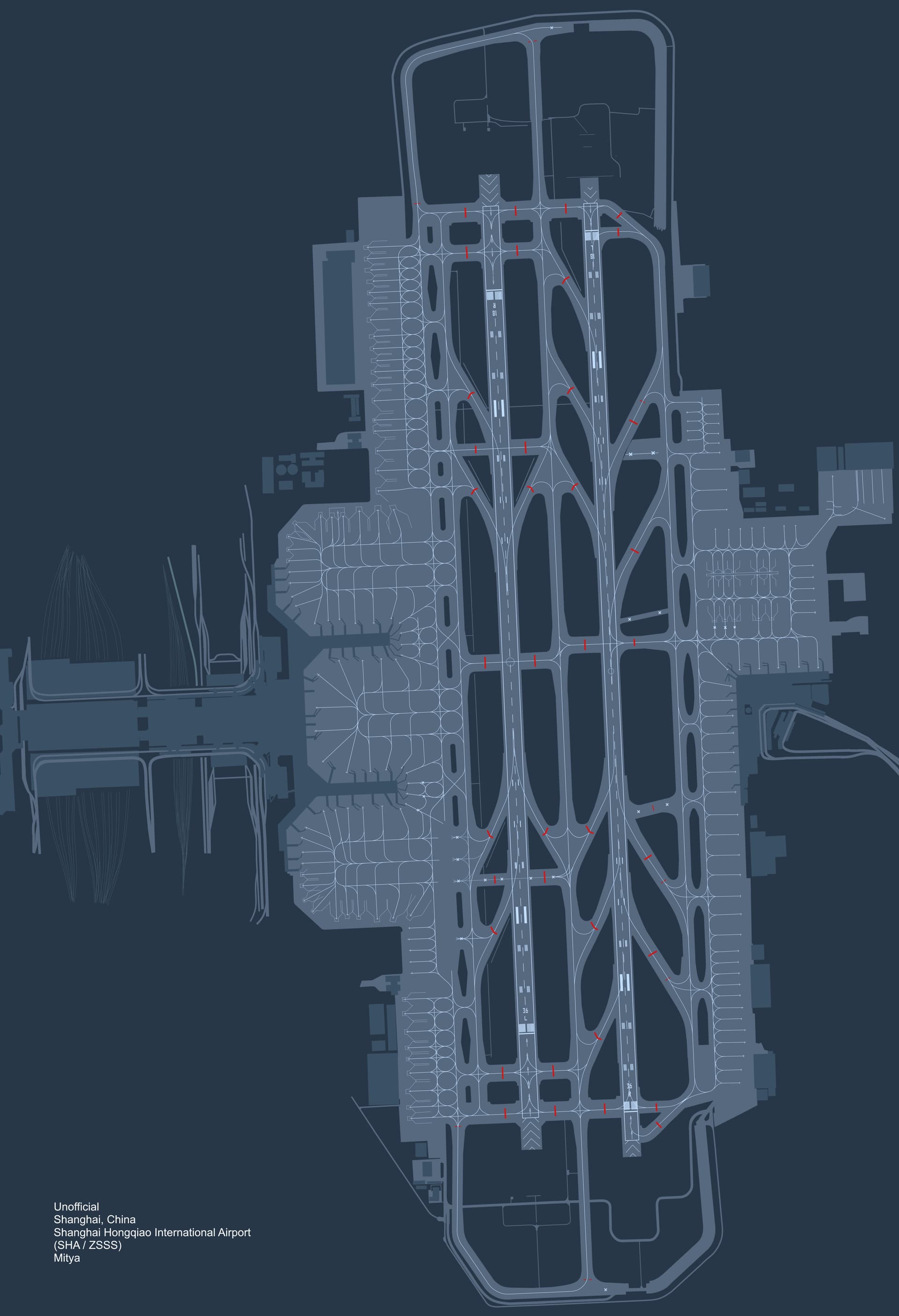
Airport Name and ICAO/IATA Code
Shanghai Hongqiao International Airport (ICAO: ZSSS / IATA: SHA)
Location (City, Country)
Shanghai, China
Airport Type & Size
Airport Type:
An international civil aviation airport, serving mainly domestic flights and a limited number of short-haul international routes (Tokyo-Haneda, Seoul-Gimpo, Taipei-Songshan, Hong Kong, Macau).Previously the main international airport of Shanghai until Pudong (PVG) opened in 1999. Since then, Hongqiao has specialized primarily in domestic flights and regional international destinations.Location & Infrastructure:
Located in the western part of Shanghai, about 13 km from the city center.
The airport has two passenger terminals:
Terminal 1 — older and smaller in size, currently handling part of domestic flights and some international services.
Terminal 2 (opened in 2010) — modern and four times larger than Terminal 1. It handles the majority of flights.
- Runways:
Two runways:
18L/36R — 3,400 m, concrete.
18R/36L — 3,300 m, concrete.Both are capable of accommodating wide-body aircraft (Boeing 747, Airbus A330, etc.).
Two parallel dependent runways (one mainly for landings, the other for takeoffs).
Capacity:
In 2023, the airport handled 42.5 million passengers, making it the 7th busiest in China and the 43rd busiest worldwide.Role & Specialization:
The primary airport for business travel due to its proximity to downtown Shanghai.
Strong integration with Hongqiao Railway Station, where high-speed G-trains stop, making the airport one of the largest transport hubs in Eastern China.
Mainly serves short- and medium-haul routes within China and neighboring regions.
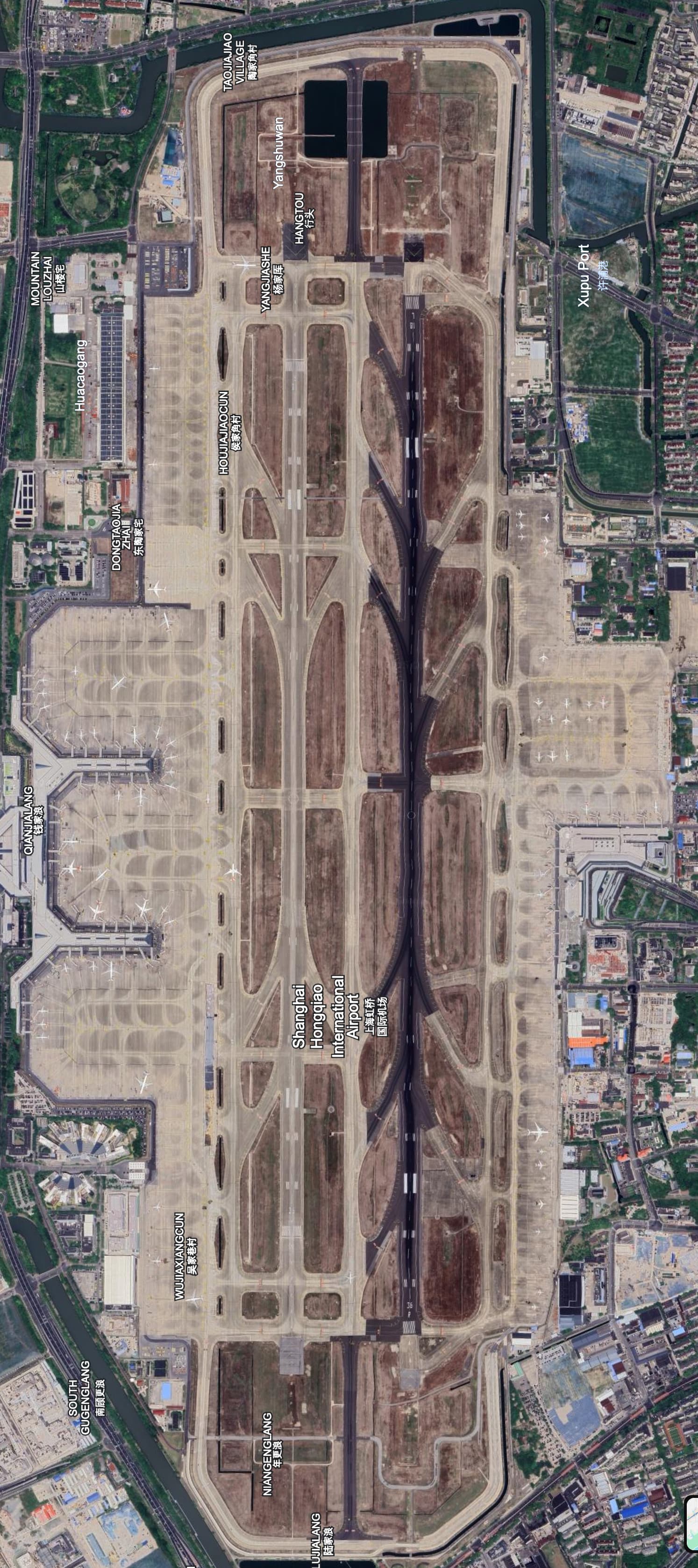
Why should this airport be added to World of Airports?
• Geographical location: The airport is located in China, in a region that currently has no in-game airports, which expands the WOA game map.
• Airline diversity: A major hub for China Eastern, Shanghai Airlines, Juneyao Air, and Spring Airlines, as well as for Air China and other leading Chinese carriers.
• Runways and gameplay actions: Two parallel independent runways allow simultaneous handling of landings and takeoffs, creating more gameplay actions (landing, takeoff, crossing).
• Theoretical size: Medium compared to other WOA airports.
• Number of stands: Sufficient number of class “E” stands for both passenger and cargo aircraft.
• Historical significance: Before the opening of Pudong Airport in 1999, Hongqiao was Shanghai’s main international airport, which gives it recognition.
• Gameplay value: Balance between short-haul flights and a small share of wide-body traffic.
• Different types of flights and aircraft: Combination of narrow-body and wide-body aircraft.
Major Airlines & Routes
Base Airlines:
• China Eastern Airlines
• Shanghai Airlines
• Juneyao Air
• Spring Airlines
• Air ChinaOther Chinese Airlines:
• China Southern Airlines
• Shenzhen Airlines
• Hainan Airlines
• XiamenAir
• Shandong Airlines
• Sichuan AirlinesInternational Routes:
• Tokyo (Haneda, HND) – ANA, Japan Airlines, China Eastern, Shanghai Airlines
• Seoul (Gimpo, GMP) – Korean Air, Asiana Airlines, China Eastern, Shanghai Airlines
• Taipei (Songshan, TSA) – China Airlines, EVA Air, China Eastern, Shanghai Airlines
• Hong Kong (HKG) – Cathay Pacific, Hong Kong Airlines, China Eastern, Shanghai Airlines
• Macau (MFM) – Air MacauKey Domestic Routes:
• Beijing (PEK, PKX)
• Guangzhou (CAN)
• Shenzhen (SZX)
• Chengdu (CTU, TFU)
• Chongqing (CKG)
• Kunming (KMG)
• Xi’an (XIY)
• Wuhan (WUH)
• Xiamen (XMN)
• Hangzhou (HGH)
• Nanjing (NKG)
• Harbin (HRB)
• Dalian (DLC)
• Qingdao (TAO)
• Tianjin (TSN)

Unique Features or Challenges
•Parallel independent runways – sequential takeoffs and landings and runway crossings.
•Compact layout – short taxi distances.
•High traffic density – frequent short-haul routes.
•Mixed aircraft types – narrow-body and wide-body aircraft.
•Fog and low cloud cover – Shanghai is often affected by fog and low visibility, especially in autumn and winter.
•Rainy weather and humidity – frequent heavy rains in summer.
•Limited maneuvering space – compact terminal and runway layout increases taxiing and flight scheduling complexity.
Optional: Links, images, maps, or videos
Wiki: Shanghai Hongqiao International Airport - Wikipediahttps://www.shairport.com/enhq/index.html


Games